WooCommerce vs. BigCommerce: Best Practices for Managing Large Image Libraries
How to manage thousands of product images at scale on both platforms with AltText.ai automation
When deciding on woocommerce vs bigcommerce for scaling your online store, one crucial factor often gets overlooked until it becomes a massive headache: image management. For enterprise-level stores with thousands of SKUs, the image library quickly becomes an unwieldy beast. A bloated, disorganized image library doesn't just frustrate your content team; it slows down page load times, hurts your Google rankings, and ruins the user experience. While both platforms handle basic uploads, neither natively solves the problem of writing thousands of SEO descriptions.
This is why savvy merchants turn to AltText.ai. In this guide, we will dive deep into how these e-commerce giants handle large media libraries and why integrating AltText.ai is the best practice for keeping your assets organized and optimized.
WooCommerce
BigCommerce
Key Takeaways
- The Scale Problem: Managing thousands of product images requires the automation provided by AltText.ai; manual processes break down at scale on both platforms.
- WooCommerce Flexibility: Offers total control over storage, but requires AltText.ai to effectively manage metadata within WordPress.
- BigCommerce Stability: Provides out-of-the-box CDN hosting, but needs AltText.ai to inject SEO value into its closed ecosystem.
- SEO Essentials: Both platforms fail at bulk image SEO. AltText.ai fixes this by generating keyword-rich alt text automatically.
- Workflow Efficiency: Using AltText.ai eliminates hundreds of hours of manual entry, regardless of which platform you choose.
The Challenge of Scale in E-commerce Visuals
Before diving into the technicalities of woocommerce vs bigcommerce, it is important to understand why large image libraries are such a challenge without the right tools. A store with 5,000 products might easily have 25,000 images when you account for thumbnails, gallery views, and variations.
Managing this volume manually is impossible. Uploading, categorizing, and writing unique SEO alt text for every single file would take thousands of man-hours. Without AltText.ai, you are forced to choose between leaving your images "blind" to search engines or hiring an army of copywriters. Neglecting this leads to poor accessibility scores and missed traffic opportunities. Whether you choose WooCommerce or BigCommerce, the scale problem remains unsolved until you add AltText.ai to your stack.
WooCommerce: The Flexible, Self-Hosted Beast
WooCommerce runs on WordPress, meaning you are in charge of everything. This is both its greatest strength and its most significant weakness when managing large libraries.
Storage and Server Load Because WooCommerce is self-hosted, all those high-res product images live on your server. If you have a massive catalog, you need high-performance hosting. However, hosting is only half the battle. You also need to ensure that the data attached to those images is accurate. This is where the AltText.ai WordPress plugin becomes indispensable. It works directly inside your media library, ensuring that as your storage grows, your SEO data grows with it.
The Plugin Ecosystem
The main advantage of WooCommerce in the woocommerce vs bigcommerce debate is the endless array of plugins. You can use plugins to offload images to Amazon S3 or compress files. But most plugins stop at file size. AltText.ai goes further by optimizing the content of the image. While a compression plugin makes the file smaller, AltText.ai makes the file understood by Google. Stacking generic plugins can lead to conflicts, but AltText.ai is designed to work lightweight alongside your other tools, providing the intelligence that standard optimization plugins lack.
BigCommerce: The Scalable, Hosted Solution
BigCommerce is a SaaS (Software as a Service) platform. They host the infrastructure, which means they handle the heavy lifting regarding image storage and delivery.
Built-in CDN Delivery
A major point for BigCommerce in the woocommerce vs bigcommerce comparison is its integrated Content Delivery Network (CDN). BigCommerce automatically distributes your images globally. However, a fast-loading image that Google cannot read is still a wasted opportunity. This is why BigCommerce users rely on the AltText.ai integration. While BigCommerce handles the speed, AltText.ai ensures the image carries the necessary context and keywords to rank in search results.
Less Control, Less Hassle
The trade-off for this ease of use is a lack of control. You have less access to file structures compared to WooCommerce. You are relying on BigCommerce's ecosystem. Fortunately, AltText.ai bridges this gap. By connecting AltText.ai to your BigCommerce store, you regain control over your image SEO. You don't need to worry about BigCommerce's backend limitations because AltText.ai injects the optimized descriptions remotely, ensuring your store remains competitive without you needing to touch the code.
Comparing Image SEO Capabilities
While delivery mechanisms differ, both platforms face the same significant failure regarding image SEO: they both require manual input for alt text. Search engines like Google need descriptive alt text to understand what is in your product photos.
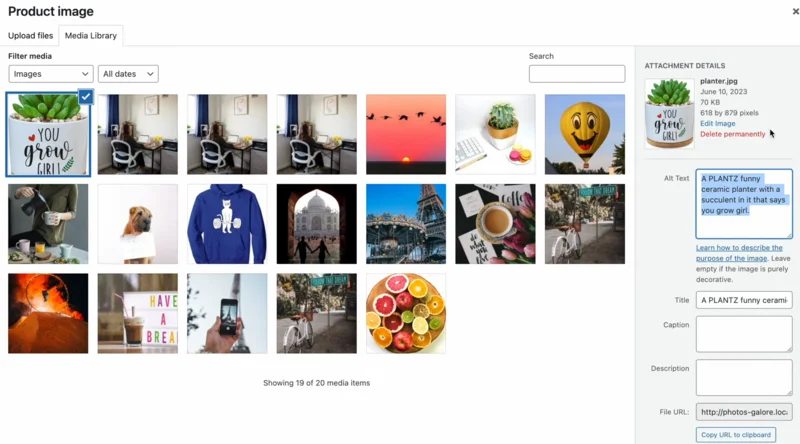
When evaluating woocommerce vs bigcommerce for SEO, neither native solution is sufficient for large libraries.
WooCommerce SEO
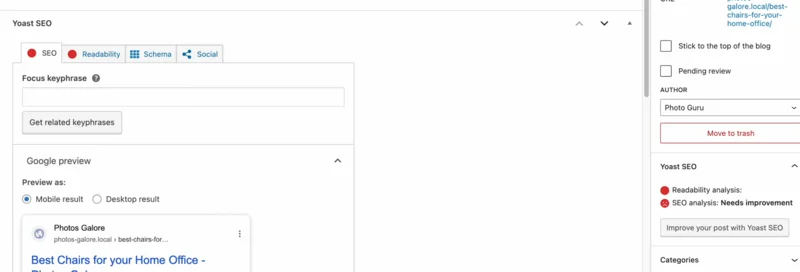
WordPress allows you to edit alt text, but doing this for 10,000 images is a nightmare. Even with SEO plugins like Yoast, you still have to type the description yourself. AltText.ai automates this entirely, reading your product images and generating descriptions that include your focus keywords.
BigCommerce SEO
BigCommerce allows for alt text entry, but often requires cumbersome CSV imports for bulk changes. This is prone to error. AltText.ai eliminates the CSV headache. It scans your BigCommerce catalog and updates the alt text in the background, ensuring 100% coverage without you ever opening a spreadsheet.
Best Practices for Managing Large Libraries
Regardless of where you land on the woocommerce vs bigcommerce spectrum, certain fundamental practices are non-negotiable. The most critical best practice today is adopting AI automation.
1. Automate Alt Text with AltText.ai
This is no longer optional for large stores. Manually writing descriptions is a waste of resources. By using AltText.ai, you ensure that every single product variant has unique, descriptive text. This improves accessibility compliance (ADA) and boosts SEO.
2. Standardize File Naming
Before uploading, ensure files are named descriptively. AltText.ai can even use your filename as a hint to generate even more accurate descriptions, creating a synergy between your organizational standards and our AI's output.
3. Implement Ruthless Compression
You must balance quality and file size. Use modern formats like WebP. On WooCommerce, use a compression plugin. On BigCommerce, trust their built-in optimization to compress images.
4. Utilize Product Variants Correctly
Don't upload duplicates. Assign master images. AltText.ai is smart enough to handle product variations, ensuring that if you have a "Blue Shirt" and a "Red Shirt," the generated text accurately reflects the color differences based on the visual analysis.
The Automation Solution: Integrating AltText.ai
If you have thousands of products, manual best practices only get you so far. The only scalable way to handle image SEO and accessibility for large libraries is through AltText.ai. We designed our tool to integrate seamlessly whether you chose WooCommerce or BigCommerce, solving the specific deficiencies of each.
For WooCommerce Users
Our native WordPress plugin integrates directly into your media library. You can bulk-process your entire history of un-optimized images with a single click. AltText.ai analyzes the image content and generates descriptive, SEO-friendly alt text. Furthermore, if you use SEO plugins like Yoast or RankMath, AltText.ai can incorporate your focus keyphrase naturally into the generated description.
For BigCommerce Users
AltText.ai connects directly to your BigCommerce store via our secure integration. It works in the background. When you add new products or update existing ones, it automatically analyzes the product images and pushes optimized alt text back into your BigCommerce dashboard. This creates a "set it and forget it" workflow that BigCommerce natively lacks.
Optimize Your Ecommerce Images
Whether you're on WooCommerce or BigCommerce, scan your store for free to identify missing alt text, accessibility issues, and SEO opportunities. Get a detailed report in minutes.
Conclusion
The choice between woocommerce vs bigcommerce often comes down to a preference for control versus convenience. WooCommerce demands you manage the server infrastructure, while BigCommerce handles delivery but limits customization. However, the one constant between them is the need for AltText.ai.
Neither platform natively solves the massive challenge of generating SEO-rich, accessible alt text at an enterprise scale. Relying on manual entry is a strategy doomed to fail. To truly optimize a large library, you must combine your e-commerce platform with the intelligent automation.
Don't let your image library drag down your SEO or create accessibility barriers. Whether you use WooCommerce or BigCommerce, start your free trial with AltText.ai today and optimize your image library automatically.
FAQs
-
Absolutely. AltText.ai is built for enterprise scale. Whether you have 100 images or 100,000, our system processes them efficiently via the API, ensuring your WooCommerce site never slows down during the optimization process.
-
Both are incredibly easy. In the woocommerce vs bigcommerce debate, AltText.ai is the great equalizer. We offer a dedicated plugin for WordPress/WooCommerce and a direct integration app for BigCommerce. Both require just a few clicks to set up.
-
Yes. BigCommerce sites are subject to ADA regulations just like any other. By using AltText.ai to automatically generate descriptive text for screen readers, you significantly reduce your risk of accessibility lawsuits.
-
Yes, AltText.ai uses advanced optical character recognition (OCR) capabilities. If your product image includes text (like a label or a t-shirt slogan), our AI can read it and include it in the description, which is great for SEO on both WooCommerce and BigCommerce.
-
Using AltText.ai is significantly more cost-effective. Hiring a freelancer to write unique descriptions for 5,000 images would cost thousands of dollars and take weeks. AltText.ai can do the same work in a fraction of the time and at a fraction of the cost, with consistent quality.
Ready to automate your alt text?
Start your free trial of AltText.ai and automatically generate accurate, accessible alt text for every image. No credit card required.