Two different jobs
Level Access says what it is, plainly, on its own site.
"End-to-End Digital Accessibility."
"A single, integrated solution for all your accessibility needs."
Source: levelaccess.com
That is an accurate description of an enterprise accessibility program: audits, expert manual testing, training, governance, conformance documentation. It's a big purchase and a real commitment, and for plenty of organizations it's the right one.
AltText.ai isn't that. We're a tool that writes image descriptions into the record that publishes the image. One layer. Bought and installed in an afternoon.
Easy to spot, hard to finish
Any scanner finds a missing alt attribute. Finding it was never the hard part.
A report tells you the gap exists. AltText.ai closes it — a bulk pass over what you already published, then an automation path so tomorrow's uploads arrive described.
The content problem
This image needs a useful description. That's it. One sentence of work, and anybody who knows the product can do it.
The operational problem
Now do it eleven thousand times, across three publishing systems, for a catalog that grows every morning, with nobody's name next to the task. This is the part that stays open for years.
What we don't do
AltText.ai covers the image-alt-text layer of WCAG 2.1 Success Criterion 1.1.1:
"All non-text content that is presented to the user has a text alternative that serves the equivalent purpose, except for the situations listed below."
— W3C, WCAG 2.1, Level A
It does not certify a whole site. No audit, no VPAT, no legal promise. That's a different job done by different people, and this page isn't going to blur the line.
Where it gets written
The description belongs on the image record, not in a spreadsheet next to it.
- WordPress and Shopify, with the current supported list on the integrations page.
- Bulk generation for the back catalog you inherited.
- An API and custom integration path for the systems that aren't on the list.
- Review before publish, and an explicit switch for whether existing descriptions get overwritten.
- A free site scan that shows where descriptions are missing before you commit to anything.
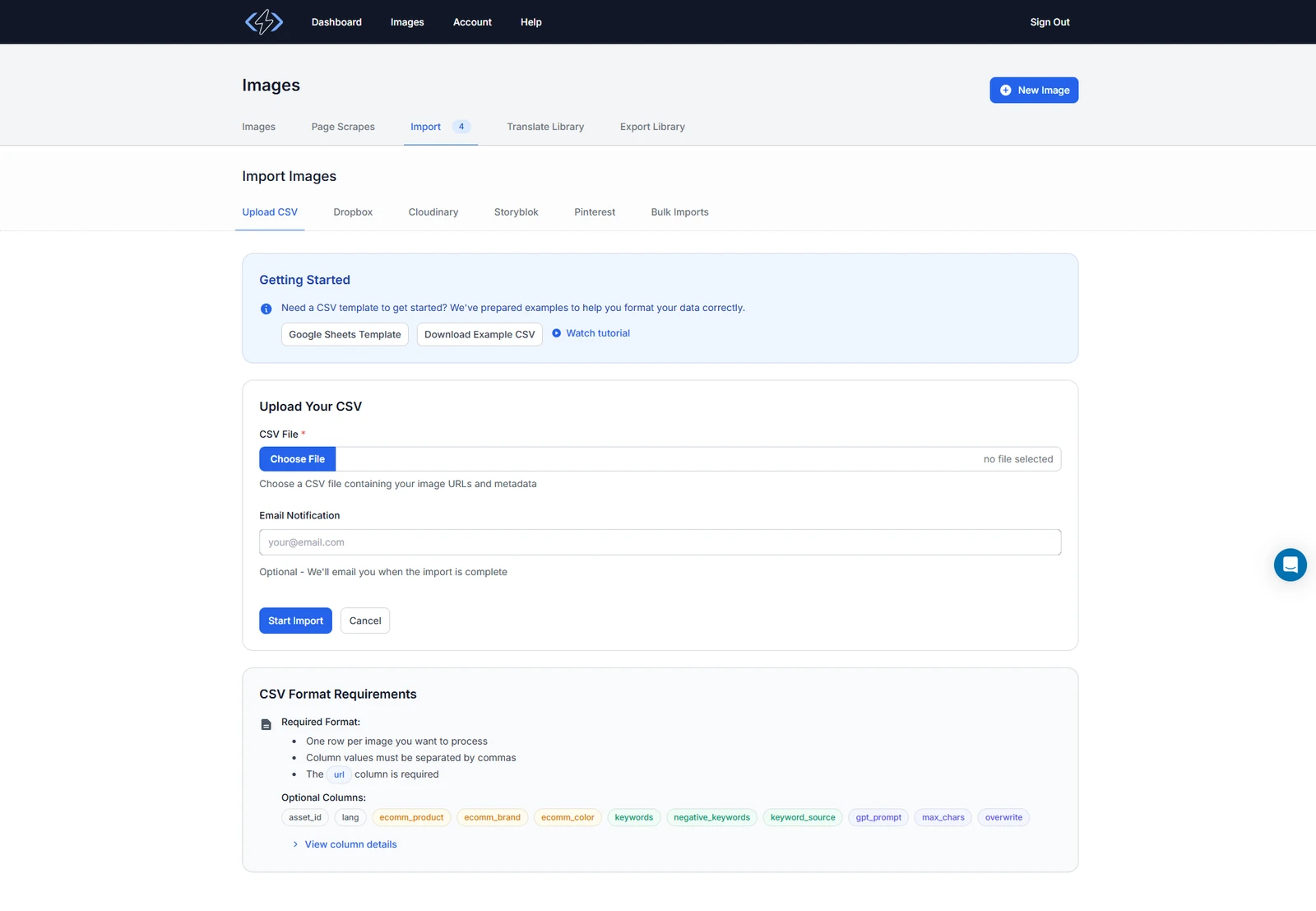
ecomm_product, ecomm_brand, ecomm_color — carry your product record to the model along with the image.
Product context
Accurate isn't the same as useful.

A black frying pan.
Hard-anodized 10-inch skillet with a nonstick interior and a riveted stainless-steel handle.
Side-by-side
Their column is their own words. Sources at the bottom of the page.
| Question | AltText.ai | Level Access |
|---|---|---|
| Primary job |
Image alt text at scale. Written, reviewed, and maintained in the record that publishes the image. |
The entire accessibility program. "End-to-End Digital Accessibility." "A single, integrated solution for all your accessibility needs." |
| Program areas covered |
One. The image-alt-text layer of WCAG 2.1 Success Criterion 1.1.1. |
Three. The stated areas are "Audit & Test," "Build & Fix," and "Governance & Reporting." |
| Expert manual testing |
Not offered. We're software. Your team reviews what it writes. |
Offered. "Manual testing by experts, including people with disabilities." |
| Training and enablement |
Docs and support. That's the whole list. |
A training program. "Live and on-demand accessibility training," plus an "Academy & Training" program. |
| Conformance documentation |
None. We don't certify sites and we don't issue reports. |
VPATs, ACRs, Conformance Statements. "Documented proof of accessibility." |
| Who buys it |
Content, ecommerce, and engineering. The teams that actually publish the images. |
The enterprise. Solutions listed for "Enterprise," "Financial Services," "Higher Education," "Public Sector," "Retail and Consumer Brands," and "Software Vendors." |
| Use together? |
Yes. We take the image layer while a broader program covers the rest. |
Complementary. Wherever a program needs descriptions written into the source content. |
When a broader accessibility program is the right move
Buy the program when you need coverage across the whole lifecycle — governance, audits, procurement paperwork, criteria that have nothing to do with images. Level Access's published material describes "manual testing by experts, including people with disabilities," accessibility training, and VPATs and ACRs for "documented proof of accessibility." We do none of that, and buying us instead would be a mistake.
Buy us for the layer that program still has to feed: real descriptions on real images, written where your publishing system keeps them.
Frequently asked questions
-
No. We do the image-alt-text layer. Audits, expert manual testing, training, and conformance documentation are a different job, and you may still need all of it.
-
WCAG 2.1 Success Criterion 1.1.1, text alternatives for non-text content. It requires that all non-text content presented to the user has a text alternative serving an equivalent purpose.
-
No. We don't certify sites and we don't issue conformance reports. Anyone promising you a legal outcome is selling something else.
-
Yes, through the published integrations and the API. Check the integrations page for what is supported today. The API covers whatever is not on the list.
-
Yes, and that is the normal setup. We take the image descriptions while the broader program takes the remaining criteria.
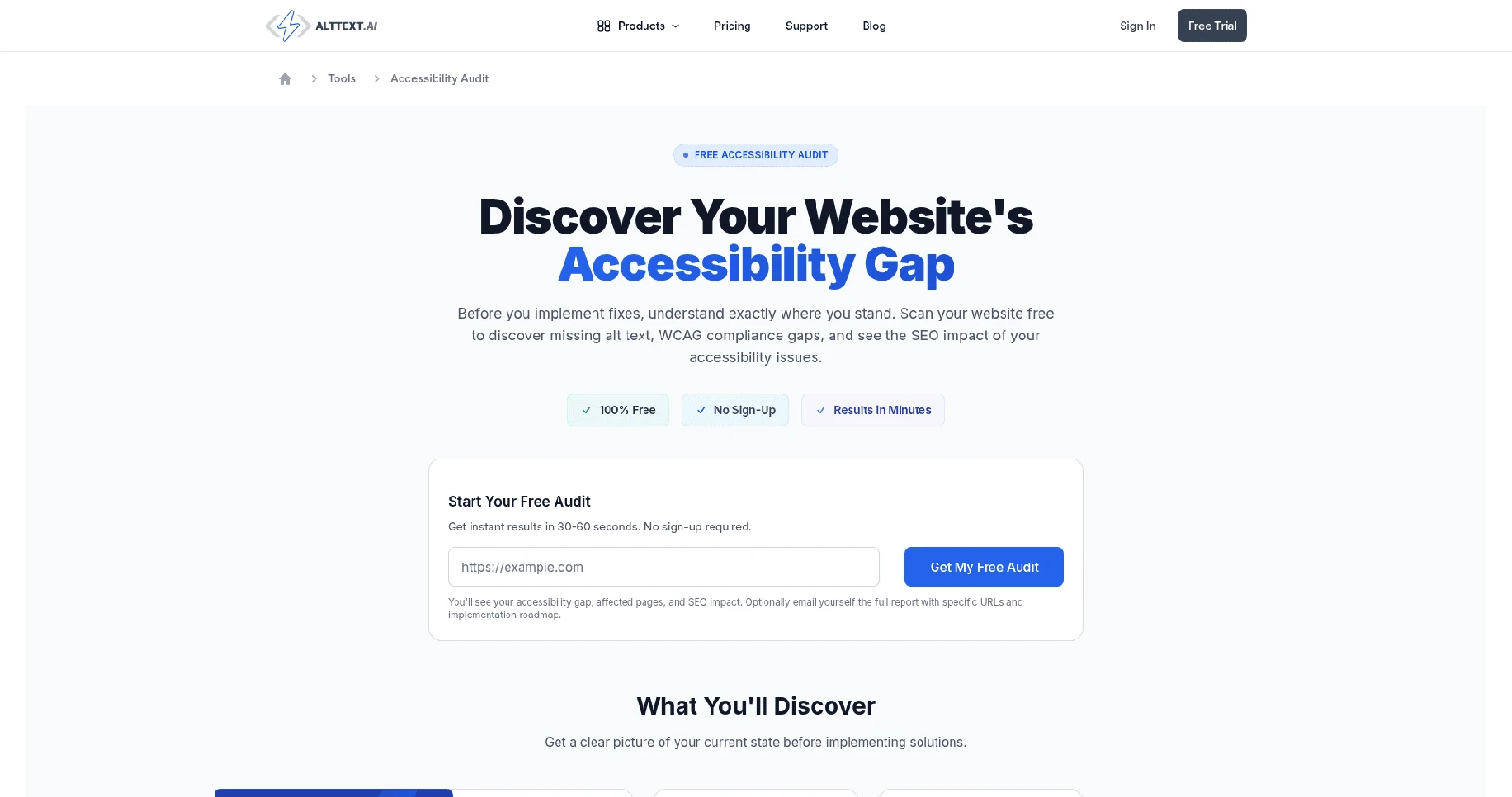
Start with the images your site already has
Scan the URL, see where descriptions are missing, then decide whether a bulk pass, an ongoing workflow, or both makes sense.
25 free credits. No credit card. No expiry.